
Why India Wants German-Made Type 214 Submarines As China-Pakistan Naval Ties Deepen
3 hours from now

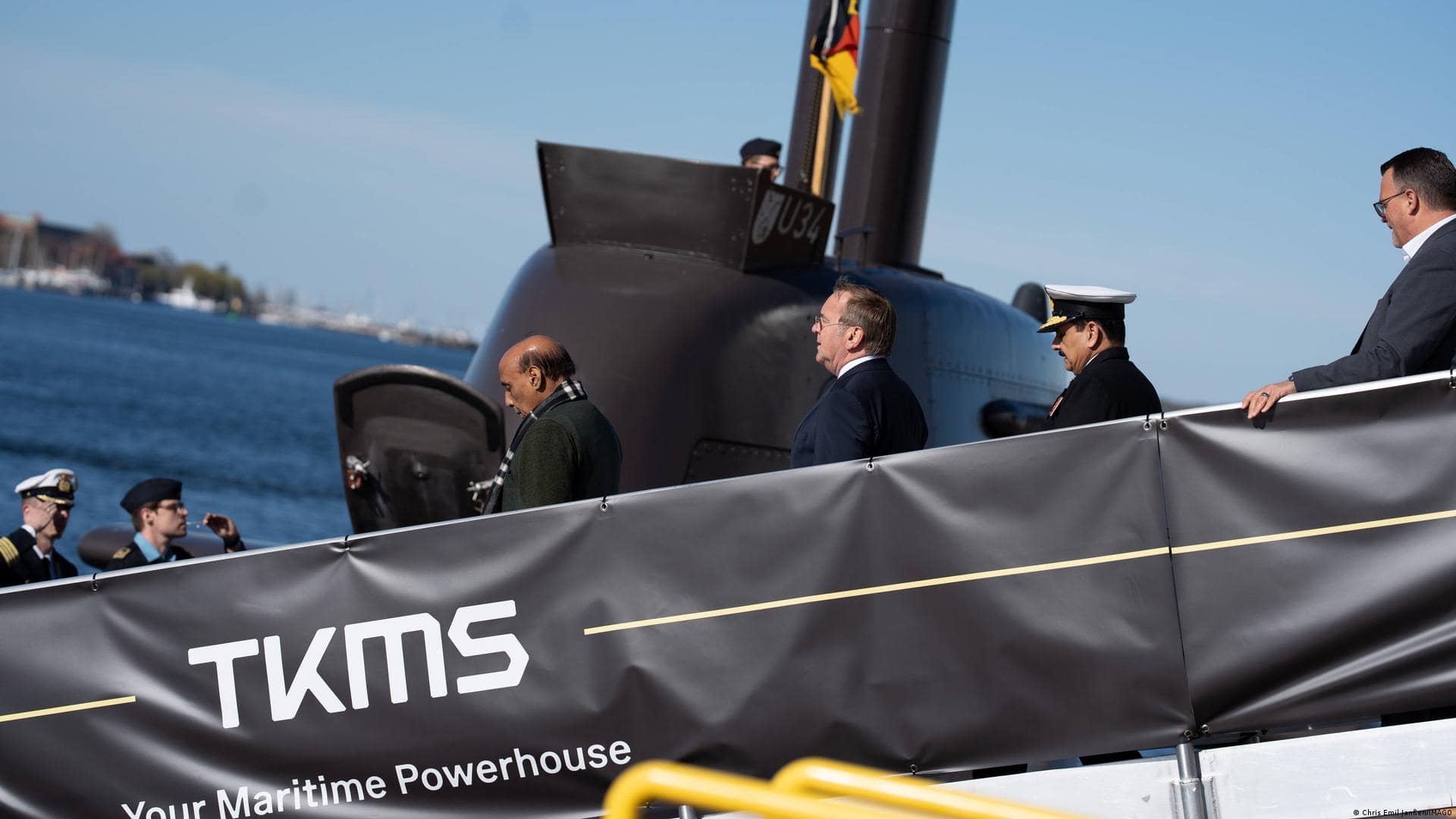
India is moving to strengthen its navy with a new generation of submarines designed in Germany and to be built in India. The deal, worth around $8 billion (€7 billion), is expected to be signed this summer, according to the German Defense Minister Boris Pistorius. The deal comes as the Indo‑Pacific turns into an increasingly contested arena, with submarines playing a central role. China's growing naval reach and Pakistan's deepening military ties with Beijing are sharpening India's sense of urgency. The submarines in question are German-designed Type 214 boats, built by Thyssenkrupp Marine Systems, or TKMS. They are diesel-electric submarines, not nuclear-powered ones. But they include key technology that makes them especially valuable: air-independent propulsion (AIP). That technology allows them to stay underwater much longer than other conventional submarines — making them harder to detect and better suited for patrols in crowded waters. India's Sea Lanes Are Vital India has more than 11,000 kilometers (about 6,840 miles) of coastline, and more than 90% of its trade by volume moves by sea. But the Indian Ocean also contains several chokepoints — narrow passages where sea traffic can be disrupted. Any threat to these routes can quickly become a threat to India's economy. "This is why it's so important for India to maintain freedom of navigation in the Indo-Pacific region", said Shairee Malhotra, Deputy Director of the Strategic Studies Program at the Observer Research Foundation (ORF) in New Delhi. "Which is why India wants to enhance its naval power. And these submarines would mark a major advancement in India's undersea warfare capabilities." Submarines are useful in this environment because they can patrol quietly, monitor enemy ships, and create uncertainty for stronger surface fleets. In a crisis, they can act as a deterrent. "Submarines are evolving into one of the most crucial capabilities in terms of maritime power in the Indo-Pacific," said Sidharth Kaushal, Senior Research Fellow for sea power at the Royal United Services Institute in London. One reason, he said, is that "the surface there is increasingly becoming a very heavily contested and even denied space." Why AIP Matters Traditional diesel-electric submarines must regularly surface to take in air for their engines. That makes them more visible and more vulnerable. AIP changes this. "What AIP allows a submarine to do is remain submerged for longer periods without a requirement to snorkel like traditional conventional submarines," Kaushal said. The German Type 214 uses fuel cells to generate electricity by combining hydrogen and oxygen. This produces power quietly and without exhaust, allowing the submarine to stay underwater for weeks. "It gives it some of the characteristics of a nuclear submarine, while at the same time retaining the advantages of a conventionally powered system," Kaushal said. Such submarines are smaller and cheaper than nuclear-powered ones. They are also very quiet — a major advantage in shallow or crowded waters. They can create a sudden threat to much larger naval forces. In a US‑led naval exercise in 2005, a small Swedish AIP submarine slipped through heavy defenses and scored simulated hits on a US aircraft carrier — twice. That seems to be exactly the kind of capability India wants as it modernizes its fleet. "For the moment, India has quite a small submarine fleet, most of which comes from Soviet times. So these are quite old," Malhotra said. "What India is really looking for is to modernize these naval capabilities." China And Pakistan Drive India's Concerns India's naval buildup is closely linked to its two nuclear-armed rivals: China and Pakistan. China now has the world's largest navy by number of ships, with around 400 vessels. Its main focus remains Taiwan and the South China Sea, but Beijing has also expanded its presence elsewhere. "We've seen China's increasing naval presence in the Indian Ocean, which is an increasingly contested theater, but also Pakistan's expanding naval capabilities," Malhotra said. Pakistan is upgrading its submarine fleet with Chinese help. In 2015, Islamabad signed a deal worth around $5 billion for eight advanced submarines from China. Four are being built in China and four in Pakistan, using Chinese technology. These Hangor-class submarines are based on the Chinese Type 039, known by NATO as the Yuan class. They also use AIP. Pakistan buys around 80% of its weapons from China. That deepening military relationship has changed the balance in South Asia and increased pressure on India. The risks are not theoretical. In May 2025, India and Pakistan fought for four days, raising fears of a wider war. India and China have also clashed along their disputed Himalayan border. India Is Moving West — But Not Leaving Russia With Pakistan aligned with China, India is increasingly looking westward for partners. For decades, the country followed a very different path. From the Mid-1960s onwards, India relied heavily on weapons from the Soviet Union. Much of its military equipment still comes from Russia, including warships, aircraft and armored vehicles. But India has gradually diversified over the last decade. France, Israel, and the United States have become more important defense partners. Germany now wants to be part of that shift. "This deal is commercially important for Germany. But geopolitics is clearly the frame," said Nina Haase, DW's Chief Political Correspondent. She accompanied German Defense Minister Boris Pistorius on a 2023 visit to India, where he held high‑level talks with Indian defense officials and political leaders. "This visit definitely showed a willingness to invest political capital", Haase said. "Germany does want to anchor itself more firmly in the Indo-Pacific at a time when global power balances are shifting and maritime security is becoming more contested. Supporting India's naval capabilities does align with Germany's broader interests in freedom of navigation, secure sea lanes and a rules-based order." She added that the deal gives India "alternatives to Russian goods," which matters to Berlin while Russia continues its war against Ukraine. "India is increasingly viewed here in Berlin as a stabilizing force in the Indo-Pacific," Haase said. Malhotra agreed that Berlin was trying to wean New Delhi away from Moscow. But she warned against reading the submarine deal as a clean break with Russia. "India is hedging rather than replacing Russia entirely," she said. India continues to buy and operate Russian systems. In March 2026, India signed a $238.5 million contract to acquire the Russian Shtil-1 air defense missiles for its navy. "Russian platforms remain important because they are more affordable. There are also fewer conditions attached when it comes to things like technology transfers," Malhotra said. Why Germany Is Willing To Share Sensitive Technology The planned deal between India and Germany is not only about selling submarines. The Type 214 boats would be built in Mumbai by Indian engineers trained by German specialists. That means technology transfer — a sensitive issue in defense cooperation. "Submarine technology has typically remained quite a closely guarded domain," said Malhotra. "The goal for India is to develop its domestic expertise to construct submarines and foster the growth of the local defense industry, while also reducing dependence on foreign suppliers." But many details of the submarine deal remain unclear — especially how much technology will actually be transferred. Germany will likely want to protect its most sensitive components and intellectual property. India, meanwhile, will want to produce as much as possible at home. "The details of this will matter a lot in terms of which technology is being transferred and which capabilities will come directly from Germany," Kaushal said. "Technology transfer always creates interdependence, industrial, political, strategic," said Haase. "This kind of cooperation does strengthen trust and does make the relationship harder to reverse. From Berlin's perspective, this is about strategic trust and long-term alignment," Haase said. "Weapons deals do bind you to another country for quite some time." A Deal With Limits For India, the submarine deal promises stronger deterrence, new jobs and greater self‑reliance. It fits New Delhi's effort to secure its maritime backyard at a time of growing competition for sea power in the Indo-Pacific. For Germany, the agreement offers major commercial benefits and a chance to play a larger role in Indo‑Pacific security — a region Berlin has identified as strategically important. But there are clear limits. India is hedging, and Germany may be over‑estimating how much political influence it can gain from the deal. India's foreign policy is shaped by a long tradition of non‑alignment. Buying German submarines will not turn the country into an exclusive partner of Germany, the EU or NATO. The Type 214 submarines could significantly strengthen India's position at sea. Yet the broader trend is more troubling. The Indian Ocean is becoming more crowded and more heavily armed. More submarines mean more patrols, closer encounters, and a higher risk of miscalculation. What begins as deterrence could turn into escalation — with consequences that are hard to control. Disclaimer: This report first appeared on Deutsche Welle, and has been republished on ABP Live as part of a special arrangement. Apart from the headline, no changes have been made in the report by ABP Live.
Click here to Read more

Related India Updates:


0
0
5 hours from now
5 hours from now
5 hours from now

5 hours from now